
Business Portal (B2B)
The problem
A current state map of the business portal existed but had never been validated with actual business owners or customers. Pain points had been identified but not tested. Research with business partners had never been conducted. The experience was being designed on assumptions.
A fundamental strategic question also sits underneath this work: whether to build, buy, or partner to deliver the future state program. The business portal work is directly informing that decision.
My approach
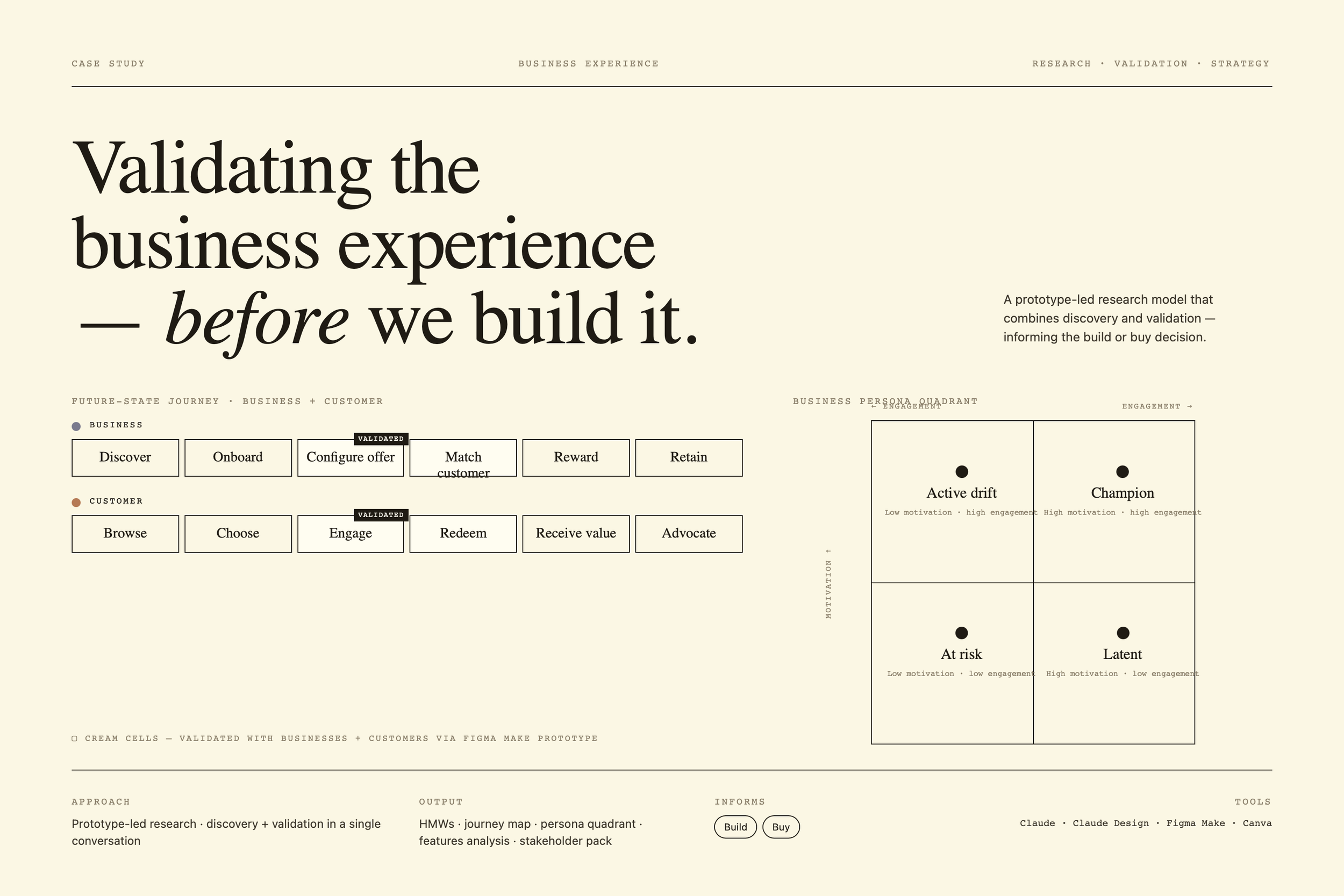
I brought a service designer onto the partner portal workstream and kicked off research with businesses for the first time. Alongside customer research, I spun up a Figma Make prototype to use during sessions, shifting the research model from purely exploratory to something more powerful: combining discovery with validation in a single conversation.
Rather than just asking businesses and cutomers what they want, we could show them something we had already thought about and ask does this solve your problem. This compressed the traditional research and design cycle significantly and brought test and learn into the shaping phase, not just delivery.
I ran focused ideation workshops using HMW statements drawn from validated pain points, consolidated insights from VOC, contact centre data, and additional data sources, and looked at what features existed in the market. From there I built a future state journey map covering both business and customer perspectives, and developed a persona quadrant mapping business motivation and engagement levels to help size and identify business segments.
Tools used
Claude, Claude Design, Figma Make, Canva, Miro, PowerPoint
What I made
Validated HMW statements, a future state journey map for business and customers, a business persona quadrant, a features analysis, and a stakeholder pack clearly indicating where validation has been applied and where it still needs to occur.
Outcome
Stakeholders have a clear view of where the design is grounded in evidence and where assumptions remain. The pack is actively being used to guide next steps, prioritisation, and the build, buy, or partner decision for the rewards program.
Limitations and learnings
Traditional linear research approaches are creating bottlenecks. When research is not conducted in an agile way, teams default to making assumptions and moving forward anyway, taking on risk without acknowledging it. The more effective model is iterative: shape, prototype, test, and refine in parallel rather than in sequence.
What's next
Continue closing the validation gaps identified in the stakeholder pack and embed the prototype-led research model as standard practice across squads.
Delivering B2B and B2C
