
Tracking the Experience
The problem
When customers need assistance, the experience of waiting and tracking help is emotionally distressing. Deep insights from data and contact centre analysis revealed clear, recurring pain points in the tracking experience that were going unresolved quarter after quarter.
My approach
I started with the data. Pulling from insights, contact centre transcripts, and existing UX research, I clustered themes and distilled them into the top three customer pain points. From there I built a one-pager synthesising qualitative and quantitative insights, turning raw data into actionable findings.
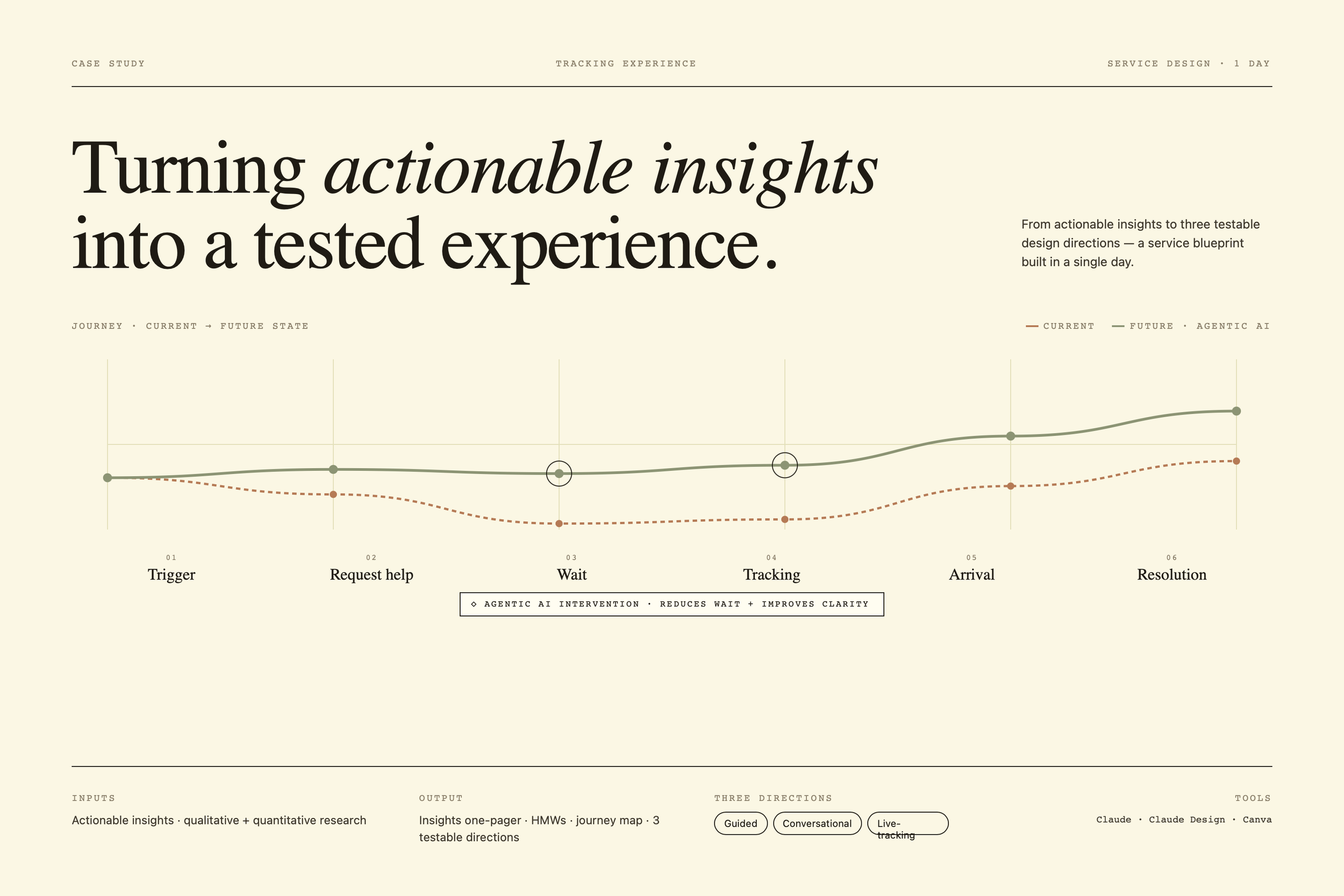
Those insights became HMW statements, which I then mapped across a current and future state journey map covering every phase of the customer experience and every channel they touch. The future state embedded an agentic AI solution at the points where it would most meaningfully reduce distress and effort.
From the journey map I moved into three design directions for the tracking experience, each grounded in a different behavioural science premise: a guided experience, a conversational experience, and a model inspired by how companies like Uber Eats solve for real-time tracking anxiety. The three directions are designed to be tested with customers to identify which is most accepted and effective.
Tools used
Claude, Claude Design, Canva, Figma, Miro
What I made
A one-pager of qualitative and quantitative insights, HMW statements, current and future state journey maps with agentic AI embedded, and three testable screen design directions, all produced in one day.
Outcome
Shared back with the product manager, UI/UX team, and broader team. What previously took weeks to produce as a service blueprint was completed in a single day. Artefacts are now moving toward customer testing and informing delivery screens.
Limitations and learnings
Sharing artefacts from Claude Design remains a challenge as outputs are difficult to render and distribute to stakeholders who don't have access to the platform. This is an active constraint worth solving as the tool matures.
What's next
The speed and quality of this approach demonstrates a new model for shaping work before it enters delivery. The goal is to embed this as standard practice across all squads, compressing the time from insight to testable concept.
Actionable insights
